Everything You Need to Know About LED Wavelength
2026-04-16
42
Catalog
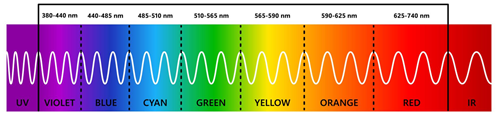
Understanding LED Wavelength
LED wavelength is the property that determines the color, energy, visibility, and application of light emitted by a light-emitting diode. It is measured in nanometers (nm) and represents the peak output of the LED. Wavelength also influences how the emitted light interacts with materials, sensors, and the human eye.
LED wavelengths are grouped into three main ranges:
Ultraviolet (UV): below 400 nm (invisible)
Used in sterilization and curing
Visible light: 400 to 700 nm
Used in lighting, displays, and indicators
Infrared (IR): above 700 nm (invisible)
Used in sensing, communication, and remote controls
How Wavelength Affects Color
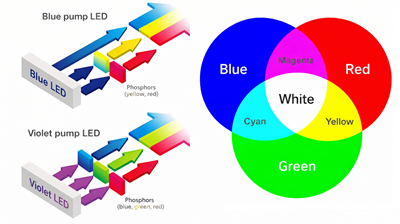
Figure 2. White Light from LED Mixing and Phosphor Conversion
LED color is determined by wavelength, which is linked to energy. Higher energy produces shorter wavelengths (blue/violet), while lower energy produces longer wavelengths (red/orange).
Color and wavelength ranges
|
Color |
Wavelength
(nm) |
|
Red |
610–700 |
|
Orange |
590–610 |
|
Yellow |
575–595 |
|
Green |
495–570 |
|
Blue |
450–490 |
|
Violet |
380–410 |
Color transitions are gradual, so ranges may overlap.
White LEDs
White LEDs do not emit a single wavelength. They use a blue LED (around 450–460 nm) and a phosphor layer that converts part of the light into longer wavelengths, which combine to produce white light.
Main metrics:
CCT (Correlated Color Temperature) shows the overall color tone, CRI (Color Rendering Index) indicates how accurate colors appear, and SPD (Spectral Power Distribution) shows how wavelengths are distributed.
Energy and Wavelength Relationship
The wavelength depends on the semiconductor energy gap:
λ=1240/Eg
• λ = wavelength (nm)
• E₉ = bandgap energy (eV)
Higher energy results in shorter wavelengths.
Common LED Materials
• GaN / InGaN: blue, green
• AlGaInP: red, orange, yellow
• GaAs: infrared
Types of Wavelength Measurement
LED wavelength can be described in two ways depending on how it’s measured.
Peak wavelength: The point of highest intensity in the spectrum, based on physical measurement, and commonly used in sensors and optical systems.
Dominant wavelength: The perceived color seen by the human eye, based on visual response, and commonly used in displays and lighting.
Peak wavelength refers to the actual output, while dominant wavelength refers to the perceived color.
Wavelength Generation
LEDs produce light through electroluminescence.
• Electrons recombine with holes
• Energy released as photons
• Photon energy determines wavelength
Wavelength is controlled by semiconductor properties.
Measuring LED Wavelength
LED wavelength is measured using special optical tools designed to analyze light.
A spectrometer measures the light output and shows the peak wavelength. A spectroradiometer measures both wavelength and color performance. An integrating sphere is often used with these tools to improve accuracy by collecting all the light from the LED.
Some tools cannot measure wavelength. A multimeter and X-ray inspection are used for electrical and structural testing, not for analyzing light.
Measurement accuracy depends on proper conditions. Temperature, driving current, and the test setup can affect the results. Changes in these factors can shift wavelength and brightness, so they must be controlled for accurate measurement.
LED Applications by Wavelength
Visible LEDs
• General lighting (homes, buildings)
• Displays (phones, TVs, panels)
• Automotive lighting
• Indicators and signage
UV LEDs
• Sterilization and disinfection
• Curing (inks, coatings, adhesives)
• Fluorescence detection
Infrared LEDs
• Remote controls
• Motion and proximity sensors
• Night vision systems
• Optical communication
Color-based uses
• Red: alerts, brake lights
• Green: signals, indicators
• Blue: backlighting, white LED generation
• Violet: inspection, specialty uses
Infrared vs Red LEDs
|
Feature |
Infrared
LED |
Red
LED |
|
Visibility |
Invisible |
Visible |
|
Wavelength |
>780 nm |
620–700 nm |
|
Function |
Sensing/communication |
Signaling |
|
Applications |
Remotes, sensors |
Displays |
Pros and Cons of LED Wavelength
Pros
• Precise color control
• Wide application range
• High spectral efficiency
• Strong compatibility with sensors
• Good color consistency (with proper design)
Cons
• Variation between production batches
• Temperature-related wavelength shifts
• Narrow spectral output per LED
• More complex design for precision systems
• Gradual color shift with aging
LED vs Laser Wavelength Characteristics
|
Feature |
LEDs |
Lasers |
|
Wavelength |
Broader range |
Very narrow |
|
Beam |
Wide spread |
Highly focused |
|
Power density |
Lower |
High |
|
Cost |
Lower |
Higher |
|
Safety |
Generally safer |
Requires precautions |
|
Applications |
Lighting, displays |
Precision, cutting |
Future Trends in LED Wavelength Technology
LED technology continues to improve, especially in wavelength control.
Emerging developments include micro-LED displays with precise wavelength control, tunable LEDs that can adjust wavelength dynamically, advanced UV LEDs for healthcare and sterilization, and full-spectrum LEDs designed for better color rendering.
These advances will improve efficiency, accuracy, and flexibility across a wide range of applications.
Conclusion
LED wavelength affects how light is produced, seen, and used in different applications. It is an important factor in color, efficiency, and overall performance. Understanding it helps explain why LEDs are widely used and how they will continue to improve in the future.
 Σχετικά με εμάς
Ικανοποίηση του πελάτη κάθε φορά.Αμοιβαία εμπιστοσύνη και κοινά συμφέροντα.
Σχετικά με εμάς
Ικανοποίηση του πελάτη κάθε φορά.Αμοιβαία εμπιστοσύνη και κοινά συμφέροντα.
δοκιμή λειτουργίας.Τα υψηλότερα οικονομικά αποδοτικά προϊόντα και η καλύτερη υπηρεσία είναι η αιώνια δέσμευσή μας.
Καυτό άρθρο
- LM358 Διπλός λειτουργικός ενισχυτής Περιεκτικός οδηγός: Pinouts, διαγράμματα κυκλώματος, ισοδύναμα, χρήσιμα παραδείγματα
- Είναι εναλλάξιμα τα CR2032 και CR2016;
- Κατανόηση των διαφορών ESP32 και ESP32-S3 Τεχνική και ανάλυση απόδοσης
- Επιλέγοντας τη σωστή μπαταρία: Οδηγός για τα AG4, LR626, LR66, 177/376/377, SR626 και SR626SW ισοδύναμα
- NPN εναντίον PNP: Ποια είναι η διαφορά;
- ESP32 VS STM32: Ποιος μικροελεγκτής είναι καλύτερος για εσάς;
- Βασικά στοιχεία τρανζίστορ BC547: Pinout, κυκλώματα εφαρμογής, εναλλακτικά/συμπληρωματικά μοντέλα
- Τι είναι το MOSFET και πώς λειτουργεί;
- Ηλεκτρικό ρελέ Basic: Λειτουργία εργασίας, τύποι και χρήσεις
- Τρανζίστορ PNP: δομή, αρχή εργασίας και εφαρμογή
 T Flip-Flop Επεξήγηση: Κύκλωμα, λειτουργία και χρήσεις
Συχνές ερωτήσεις [FAQ]
1. What is the typical wavelength range of LED lights?
LEDs typically operate between 380 nm and over 1000 nm, covering ultraviolet, visible, and infrared ranges depending on the application.
2. Why is LED wavelength important in lighting design?
It ensures the correct color output, visual comfort, and performance for specific uses like displays, signals, or ambient lighting.
3. Can LED wavelength affect human vision or eye comfort?
Yes, shorter wavelengths like blue light can cause eye strain, while balanced wavelengths improve comfort and visibility.
4. How do manufacturers control LED wavelength?
They adjust the semiconductor materials and energy bandgap, which directly determines the emitted wavelength.
5. Do all LEDs maintain the same wavelength over time?
No, wavelength can shift slightly due to heat, aging, and material degradation, affecting color consistency.
6. What happens if the wavelength of an LED is not accurate?
It can lead to color mismatch, reduced performance, and poor compatibility in displays, sensors, or lighting systems.
7. How does LED wavelength affect sensor performance?
Sensors require precise wavelengths to detect signals accurately, especially in infrared communication and optical systems.
Καυτός αριθμός εξαρτήματος
 C1005C0G1H060C050BA
 CL21F225ZAFNNNE
 GRM1885C1H150JA01D
 1808WC122KAT2A
- GRM1885C2A1R9CA01D
 06035A151GAT4A
 C1608X7R1C683K
 EMK042CG390JC-FW
 TWCD187K025SCYZ0000
 TP1.5KE30CA
- VE-253-IX
- MCIMX6S5DVM10AC
- MAX3173CAI+T
- SP3232EHEY-L/TR
- A3950SEUTR-T
- VE-2T1-EW
- XC95288XL-7PQ208I
- DCP010505BP
- MC74HC00AFEL
- TSB41LV03APFP
- TPS5130QPTRQ1
- NCV8403STT1G
- AD7776AR
- A3983SLPT
- BCM6358SRKFBG
- EN5312QI-T
- IDT72V255LA10TF
- IPP200N25N3G
- LB8115W-NA-TLM-E
- LP5900TLX-1.8
- MAX24605EXG
- MAX9390E
- MAX974CSE
- MC74LCX16244DTR2
- PL613-01-K65
- QM03N65U
- S1A0426C02-SO
- UPD78F0058GK-9EU
- MT8633DGAG/C
- FMM320C0B-12IA
- KPS28010CTLD
- LU82547GZ
- VSP6244A
- MAX-8Q-0-10
- LQG15HH10NG02D
- KD2404PFB3 11
- TPS7B8750QDDARQ1
- 127000-2204
- VI-MU3-CS